Quay or Pier: Two Coastal Structures, Two Different Uses
Quay or pier: learn to tell these coastal structures apart by their shape, setting and daily use, so you can read a harbour with more confidence.
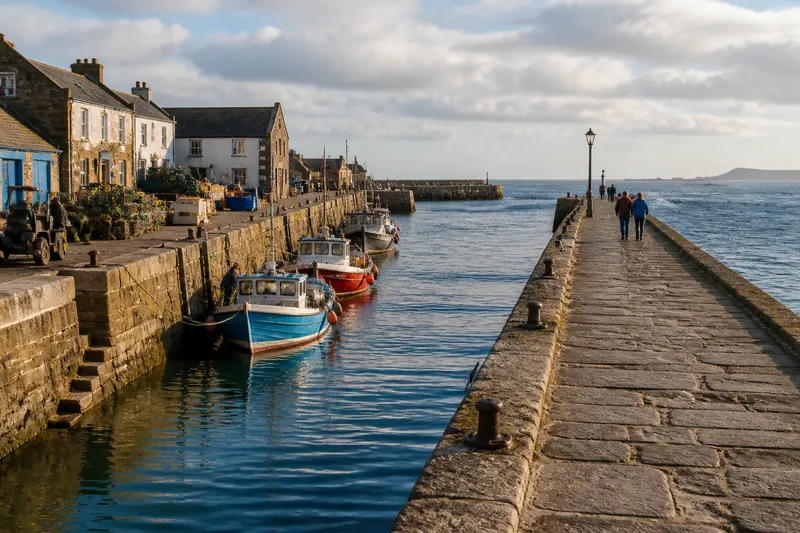
A quay usually runs along the edge of a harbour; a pier usually reaches out from shore into the water. That simple distinction helps you tell a quay or pier apart on a coastal walk, but the useful clues go beyond direction: look at the water beside it, the way boats meet it and what people do there.
Names can vary from place to place, and a structure may have changed jobs over time. Treat the word on a sign as one clue, then read the structure itself. These seven observations make the difference easier to see.
1. Which way does the structure run?
Start with its position. A quay commonly follows the shoreline or encloses part of a harbour basin. Its working face is set beside water, so a vessel can come alongside it. From above, it may look like a straight or curved edge between land and harbour.
A pier projects from land into open water or across a shallower area. You can often see water on both sides of its length. It may lead to a landing point, a larger platform or simply a place to walk out over the water.
Imagine you arrive at a small harbour and see a broad stone edge tracing the inside of the basin, with fishing boats tied parallel to it. That form and position point to a quay. A narrow walkway extending from the beach, with water on either side, reads as a pier even if both structures are built from masonry.
2. What does the structure look like at water level?
Many quays are solid and substantial. Stone blocks, concrete or a sheet-pile wall may hold back land while creating a firm face for boats to lie against. Look for bollards, rings, fenders, steps or a sloping landing. These features make sense where people need to secure and reach vessels.
Piers vary more. Some are solid, especially where they protect a harbour or carry heavy loads. Others stand on piles, leaving gaps beneath the deck. A pier can be a simple timber landing or an expansive structure with a broad deck; its defining clue is its projection, not a particular building material.
Construction alone can mislead. A concrete structure is not automatically a quay, and timber does not automatically mean pier. Read the shape together with the way the structure meets the shore and the water.
3. How do boats approach it?
At a quay, boats generally approach from the harbour side and settle along the face. The vessel’s side runs roughly parallel to the edge, with mooring lines led to posts or rings. That arrangement suits loading, unloading, landing passengers or keeping working boats close to shore.
A pier can receive boats at its outer end, along one or both sides, or at a landing stage attached to it. A ferry pier, for instance, may give passengers access to a vessel that stops at the seaward end. In a protected harbour, a projecting pier might also guide boats toward a sheltered entrance rather than serve as a routine mooring edge.
Notice the route a boat would take. If it can glide in beside a long shore-parallel wall, the form favors quay use. If it must travel around or toward a projection to reach a landing, the structure is acting more like a pier.
4. Who uses the space, and for what?
Quays are closely tied to the working edge of a harbour. You may see fishing gear, cargo, service vehicles, boat crews and people tending lines. The space behind the edge may connect directly to sheds, a fish market, a boatyard or a harbour road.
Piers more often extend public access, though some are firmly part of working transport. A walking pier may carry benches, lamps or a small shelter. A passenger pier may have a waiting area and a clear path to a landing. A structure used by visitors can still have operational rules, so observe signs and keep clear of mooring lines and loading activity.
Use is a clue, not a definition. A busy public quay remains a quay if it follows the harbour edge. A pier can support commercial activity if its position and layout serve boats or passengers.
5. What is the structure doing for the water?
Some projecting structures are built to shelter a harbour entrance or reduce the force of waves. In that role, a pier may behave as a breakwater, although the words are not interchangeable in every place. Look at whether it stands across an exposed approach, rather than assuming every pier is designed mainly for strolling or docking.
A quay’s usual job is more directly tied to the land-water boundary: it provides a stable edge where vessels can come alongside and goods or people can move between boat and shore. A quay can contribute to harbour protection, but its position beside a basin is a more reliable identifying clue than any single engineering purpose.
When visiting, look at the sheltered water behind a projecting wall and the more exposed water beyond it. That contrast can help explain why a structure reaches out from shore. It also reminds you that the shape may answer a practical harbour need rather than a visitor’s desire for a view.
6. What clues help when the name is unclear?
Local names are not always tidy. A promenade or landing may be called a pier even if it has quay-like sections; an old quay may now carry a public walkway. If the sign does not settle the question, use several visible clues rather than forcing a single label.
- Trace the shoreline: Does the structure follow the edge, or project across the water?
- Check both sides: Is water visible along both sides of the main length?
- Look for mooring points: Are boats secured parallel to a harbour-facing wall?
- Notice the landing: Does a vessel meet the structure at an end, a side or a separate stage?
- Read the surroundings: Are there working sheds and harbour access, or a public route extending out over the water?
No single item settles every case. A long harbour wall may have a public path, and a pier may include a solid quay-like landing. The strongest reading comes from combining the structure’s position with the way boats and people use it.
7. How can you read a mixed or altered harbour?
Older waterfronts often join structures with different purposes. A quay may turn into a pier, or a projecting walkway may connect to a working wall. Rebuilding can also change the surface while leaving the broad layout intact. Follow the route with your eyes: identify where the shore-parallel edge ends and where the structure begins to reach out into the water.
Say you are walking beside a harbour basin and reach a broad platform that bends away from the land. Small boats are tied along the inner wall, while a marked passenger landing sits near the far end. You could describe the first part as quay-like and the outward section as pier-like, rather than treating the whole complex as one unmistakable type.
This is often the clearest way to read a place without getting caught on a label. A quay or pier is not only a name on a map; it is a relationship between shore, water, boats and access. Start with the structure’s direction, then check what happens at its edge. You will have a grounded answer—and a sharper sense of how the harbour works.